Vehicles / free worksheet
DVIR form: driver vehicle inspection report template
A DVIR is a driver vehicle inspection report that identifies a vehicle and records safety defects or deficiencies. Use this free PDF or Excel worksheet to document findings, repair certification and driver review. Check which rules cover your operation first: a chauffeur car and an interstate passenger carrier can have different obligations.
No signup required. Blank working files; adapt them to your operation and applicable rules.
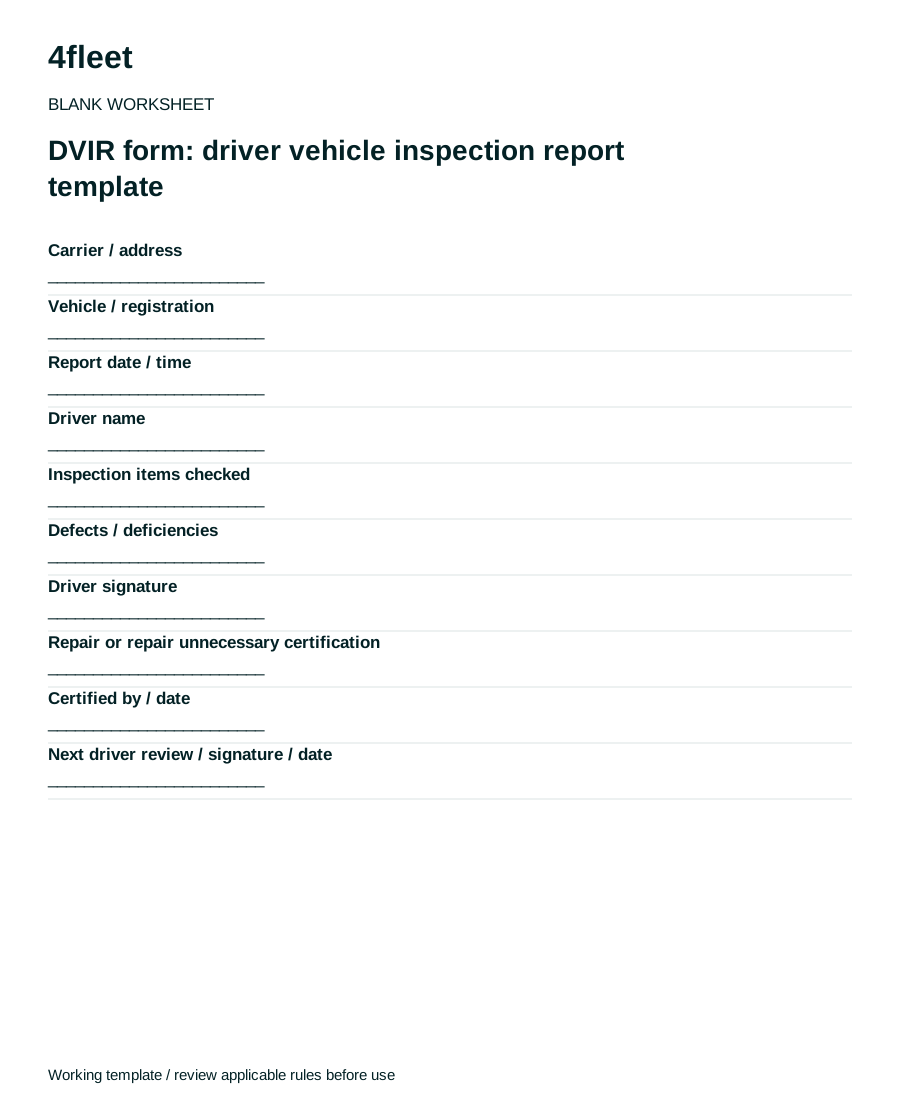
What a DVIR must contain
The form separates findings from corrective action. Add vehicle-specific equipment and the applicable Canadian inspection schedule where needed. A completed worksheet is not a safety certificate.
| Field block | What to record |
|---|---|
| Vehicle and report | Record the carrier, vehicle identifier, driver, date and time. Use a separate report for each vehicle when a report is required. A registration or fleet number makes the report traceable even if two vans share the same model and colour. |
| Equipment | Check service and parking brakes, steering, lights and reflectors, tires, horn, wipers, mirrors, coupling devices, wheels and rims, and emergency equipment. Record inapplicable equipment clearly. These prompts do not supply the mechanical knowledge needed to assess a fault. |
| Defect description | Describe the location and symptom in words. Record faults reported to you as well as those you find yourself. Keep the original finding readable; a vague tick beside a component does not tell a repairer what happened. |
| Corrective action | Keep a separate carrier or agent certification that the listed defect was repaired or repair was unnecessary. Identify who made that decision and when. Do not prefill a repair decision or let a driver signature stand in for it. |
| Driver review | Use the review line to acknowledge the previous report and required repair certification before driving. Keep the report, repair record and review together so someone reviewing the vehicle history can follow the sequence. |
When to complete and sign a DVIR
Review before driving
Check that the vehicle is safe, review the last required report and acknowledge the repair certification as required by section 396.13. The previous report is evidence to review, not a substitute for noticing a new problem.
Record the working day
Note defects discovered or reported during operation. Follow the operator safety procedure immediately when a defect affects safe use; do not wait until the end of the day to tell the responsible person about an unsafe vehicle.
Complete and close the report
Where required, prepare and sign the end-of-day report. The carrier resolves safety-affecting defects before reuse and certifies repair or that repair is unnecessary. The next driver reviews that evidence before taking the vehicle out.
US and Canada trip inspection rules
United States: coverage
FMCSA covers interstate vehicles carrying 9-15 people, including the driver, for direct compensation under parts 390-396. Larger passenger vehicles can also qualify. The 16-or-more-person threshold includes the driver; capacity is not simply the number of paying passengers on this job. Check weight, use and exceptions too.
FMCSA small passenger-carrying vehicles · verified on 2026-10-20United States: reporting
Current section 396.11 does not require no-defect reports. It exempts nonbusiness private passenger carriers, driveaway-towaway operations and carriers operating only one commercial motor vehicle. These exceptions do not establish that an unsafe vehicle may be driven. State or other requirements may differ.
49 CFR 396.11 - reporting, repairs and retention · verified on 2026-10-20Canada
NSC Standard 13 addresses trip inspection, but provinces and territories implement the framework. Confirm the applicable vehicle class, inspection schedule, report fields and retention rules locally. This US-oriented worksheet is not a replacement for a provincial prescribed schedule.
CCMTA National Safety Code, Standards 9 and 13 · verified on 2026-10-20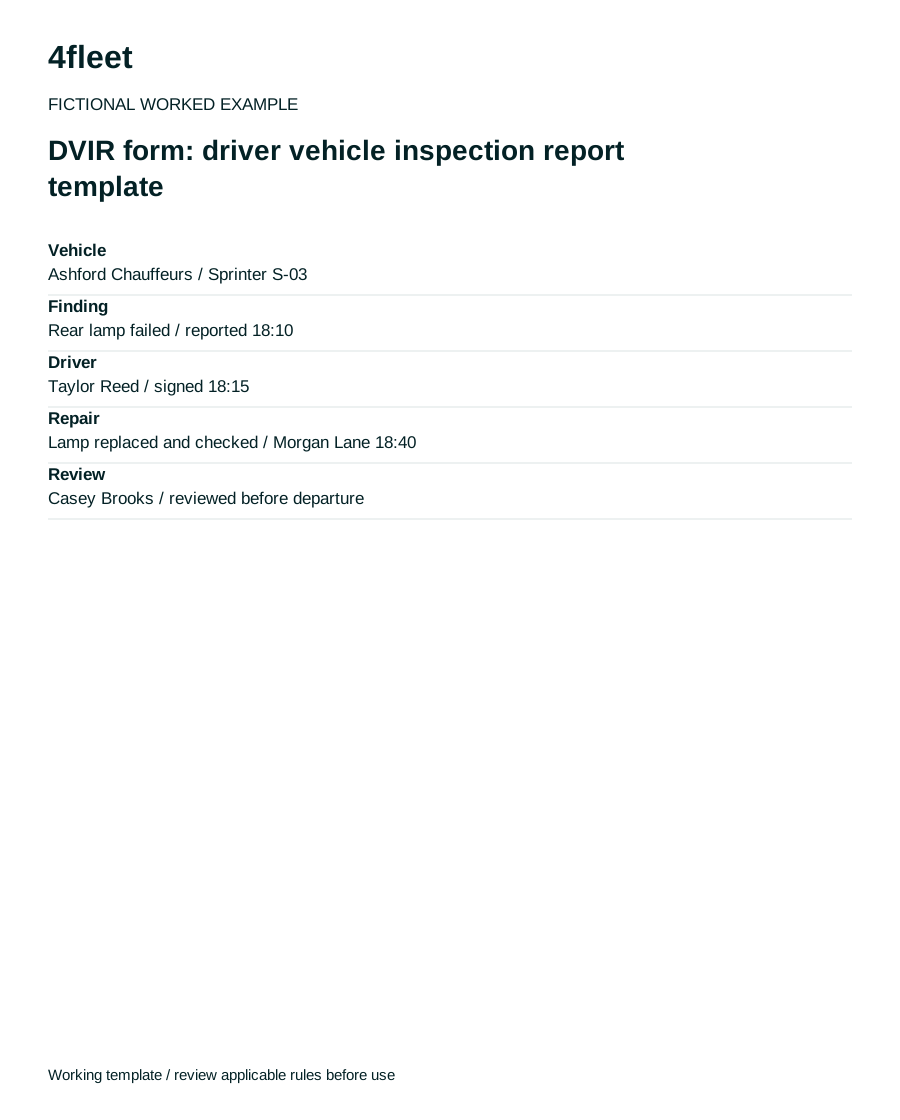
From blank sheet to useful record
A completed DVIR
The fictional Ashford Chauffeurs Sprinter report records a failed rear lamp after the working day. Taylor Reed signs the finding; Morgan Lane records replacement and a successful check before release. Casey Brooks reviews the repair certification before the next departure. The names, vehicle and times are demonstration data. They show the order of records, not a real repair, a prescribed inspection interval or a claim that a template alone meets every jurisdiction requirement.
- Vehicle
- Ashford Chauffeurs / Sprinter S-03
- Finding
- Rear lamp failed / reported 18:10
- Driver
- Taylor Reed / signed 18:15
- Repair
- Lamp replaced and checked / Morgan Lane 18:40
- Review
- Casey Brooks / reviewed before departure
Keeping vehicle records alongside the DVIR
Keep defect reports, workshop actions and vehicle documents linked by vehicle reference. Retain originals and assign responsibility for closing each defect.
4fleet vehicle maintenance records include an inspection type, and vehicle documents can carry expiry dates. Those records can sit alongside your separate DVIR process. The fleet view below shows document readiness and the expiring-documents filter. It does not show a completed DVIR, and 4fleet does not provide this statutory form inside the driver app.
See driver and vehicle operations
The fleet table shows document readiness. Keep the separate defect report and repair evidence with the vehicle record.
DVIR questions
What does DVIR stand for?
DVIR stands for driver vehicle inspection report. Keep the formal report separate from passenger-presentation checks such as water, chargers or a clean cabin.
What is a DVIR?
It is a vehicle-specific written defect report, with the required signatures and corrective-action evidence. This worksheet provides spaces for those records but does not determine whether the rules apply to your business.
When are you required to complete and sign a DVIR?
Where section 396.11 applies, prepare the required report at the end of the working day and sign it. Its current text does not require a report when no defect or deficiency was found or reported.
Is a DVIR required by the DOT for passenger vehicles?
It depends on the vehicle, operation and exceptions. Interstate passenger-capacity and compensation rules matter; the reporting section also exempts a carrier operating only one commercial motor vehicle. Check the cited rules before choosing your process.
How long must DVIRs be kept?
Under section 396.11(a)(4), covered carriers retain the report, repair certification and driver-review certification for three months from preparation. Canadian and other applicable retention rules must be checked separately.
General information, not legal or tax advice. Sources verified on 2026-10-20; check the relevant authority before acting.