Vehicles / free worksheet
Mileage log template for chauffeur and limo drivers
A chauffeur mileage log should connect each journey to its date, vehicle, purpose and distance. This free Excel and PDF template separates paid miles from deadhead miles, with a job reference and odometer fields. Use one distance unit per sheet and keep the supporting records your tax authority requires for your circumstances.
No signup required. Blank working files; adapt them to your operation and applicable rules.
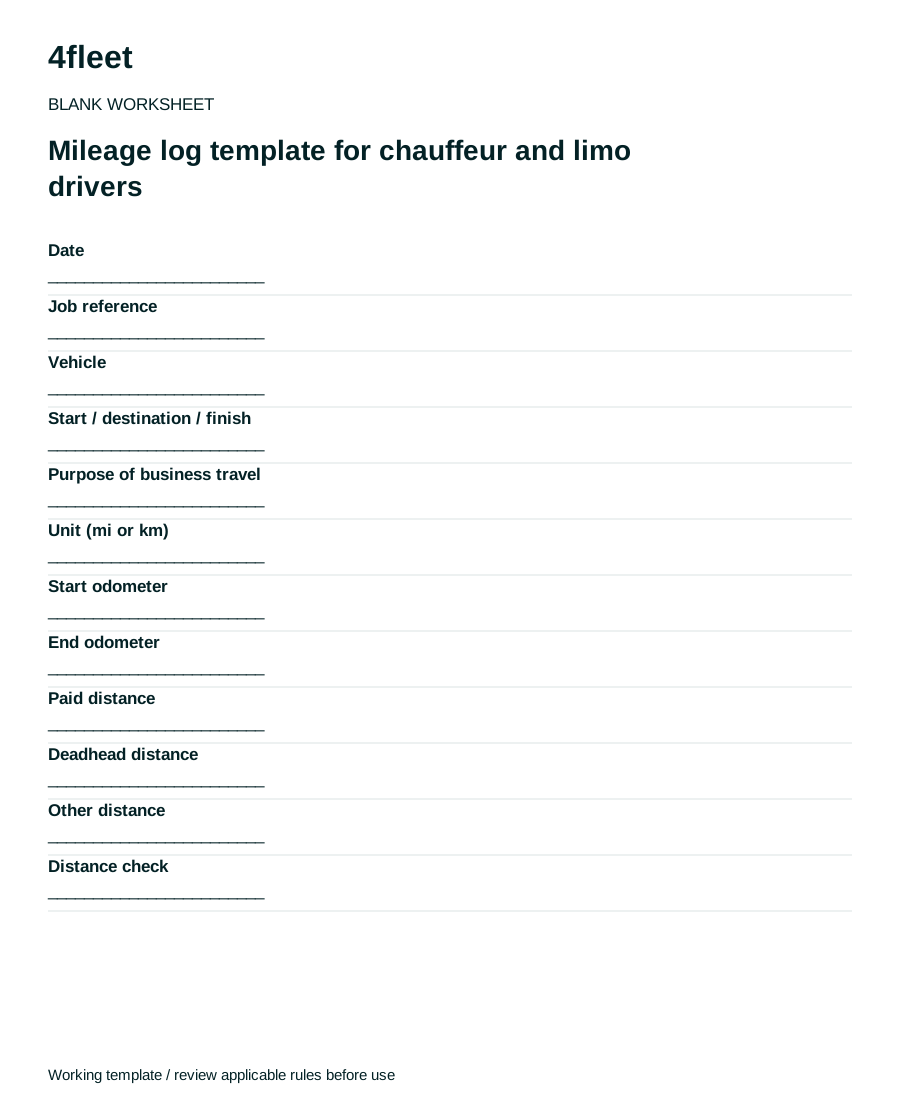
What the mileage log contains
Keep paid, empty and other distance separate. The workbook reconciles these categories to the odometer difference; it does not decide deductibility or set a reimbursement rate.
| Field block | What to record |
|---|---|
| Date, vehicle and job | Record the booking reference without unnecessary passenger details. Identify the vehicle on each row. Start a new row when changing cars; never combine different odometers. |
| Route and purpose | Write the starting point, destination, finish and business reason while the details are fresh. Airport transfer alone may not explain an empty repositioning journey, so describe the link to the next booking in your own words. |
| Readings and units | Enter actual start and end readings and choose miles or kilometres. Do not mix units in one workbook. The sheet flags a negative difference or a mismatch between the readings and the classified distance. |
| Paid and deadhead distance | Enter distance with passengers separately from empty approach, repositioning and return distance. Record other distance in its own column, with the purpose explained. Empty does not automatically mean deductible, and occupied does not automatically mean invoiced per mile. |
| Supporting records | Keep receipts, annual vehicle totals and any required fiscal-period readings outside the job rows as well. The template helps organise evidence; a calculated total does not prove a tax deduction or replace the authority recordkeeping rules. |
How to log mileage per job
Start with the vehicle
Choose the vehicle and unit before entering readings. Record the beginning of the working period and retain the fiscal-period evidence separately. Do not reconstruct missing odometer readings from a route estimate and present them as observations.
Separate the movements
Give paid, empty and other movements their proper categories. Record the job reference and purpose, including repositioning that belongs to another booking. Keep corrections readable and explain unusual detours rather than forcing a planned distance to match.
Reconcile before filing
Check the odometer difference against paid, deadhead and other distance. Investigate a CHECK result in Excel. Review the week by vehicle, attach receipt references and preserve the completed file with the period records.
Mileage record rules in the US, UK, Canada and Ireland
United States
IRS Publication 463 describes records supporting business use, including each business use and total annual mileage. Keep timely evidence of the date, destination and business purpose. Do not treat a populated spreadsheet as proof that every listed mile is deductible.
IRS Publication 463, recordkeeping · verified on 2026-10-20United Kingdom
HMRC employee guidance calls for records supporting travel claims, including mileage details and supporting receipts. Your position as an employee, sole trader or company operator matters. Check the appropriate guidance instead of applying an employee allowance rule to every business.
HMRC employee travel records, chapter 12 · verified on 2026-10-20Canada
CRA lists date, destination, purpose and kilometres for each business trip, plus opening and closing fiscal-period odometer readings. Keep separate records for each vehicle. The workbook uses full journey rows; it does not implement CRA simplified-logbook eligibility.
CRA motor vehicle records · verified on 2026-10-20Ireland
Revenue employer reimbursement guidance lists the journey date, reason, kilometres, start, destination, finish and reimbursement basis. It requires six-year retention after the relevant tax year. This specific employer rule should not be presented as blanket guidance for every operator expense.
Irish Revenue travel and subsistence records · verified on 2026-10-20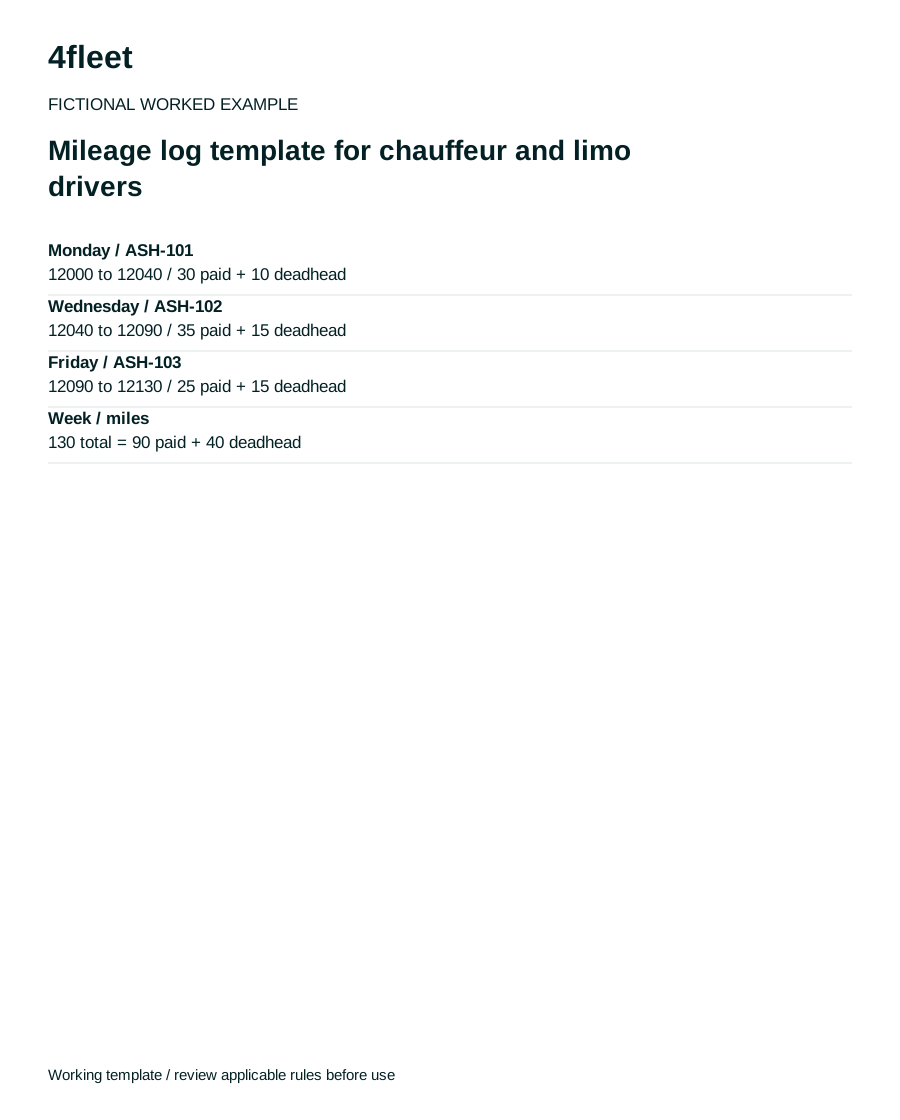
From blank sheet to useful record
A completed week
This fictional three-job week uses miles and one Ashford Chauffeurs vehicle. The rows total 90 paid miles, 40 deadhead miles and zero other miles, matching 130 miles of odometer movement. The distance check passes because the arithmetic reconciles. That result is not a tax ruling: the purpose, supporting records and applicable rules still determine how each movement is treated. The downloadable workbook starts blank, so these demonstration readings cannot accidentally become your own records.
- Monday / ASH-101
- 12000 to 12040 / 30 paid + 10 deadhead
- Wednesday / ASH-102
- 12040 to 12090 / 35 paid + 15 deadhead
- Friday / ASH-103
- 12090 to 12130 / 25 paid + 15 deadhead
- Week / miles
- 130 total = 90 paid + 40 deadhead
Paid and empty miles in 4fleet
Keep the job reference beside distance records and receipts. Record diversion reasons so the office can compare planned and actual movement.
4fleet job routes can carry planned distance calculated through Google Maps. That helps put a route beside the booking, while this mileage log records your own actual readings and classifications. Planned route distance is not an odometer record or a tax log. This page does not promise paired start/end odometer capture for every job in 4fleet.
Explore connected booking records
The route sits beside the job. A planned route is separate from the actual odometer readings in your mileage log.
Mileage log questions
What should a mileage log include?
Include date, vehicle, route, business purpose, distance and the job reference. Add actual readings and supporting records required for your situation, keeping each vehicle and distance unit identifiable.
How do I log mileage for taxes?
Record journeys promptly and follow the tax authority guidance for your status and claim. This log organises evidence; it does not select a deduction method or apply an official mileage rate.
Do I need odometer readings?
Keep the readings required by your authority. CRA specifically requests fiscal-period opening and closing readings; per-job start/end fields here also help reconcile actual distance. Never label a map estimate as an observed reading.
Should deadhead miles be logged?
Yes, record empty movements so the operating total is complete and the purpose is visible. Whether a particular movement qualifies for tax treatment is a separate question.
How long should mileage logs be kept?
Use the retention period for your authority and circumstances. Irish Revenue requires employer travel-reimbursement records for six years after the relevant tax year; that rule is not a universal period for every logbook.
General information, not legal or tax advice. Sources verified on 2026-10-20; check the relevant authority before acting.