Drivers / free worksheet
Driver log sheet and trip sheet template for chauffeurs
A chauffeur trip sheet records what happened on a job: spot time, arrival, passenger on board, drop-off, waiting and agreed extras. Download the printable sheet and daily Excel log to keep those details together. This operational record is separate from any legally required hours-of-service log, electronic logging device or tachograph record.
No signup required. Blank working files; adapt them to your operation and applicable rules.
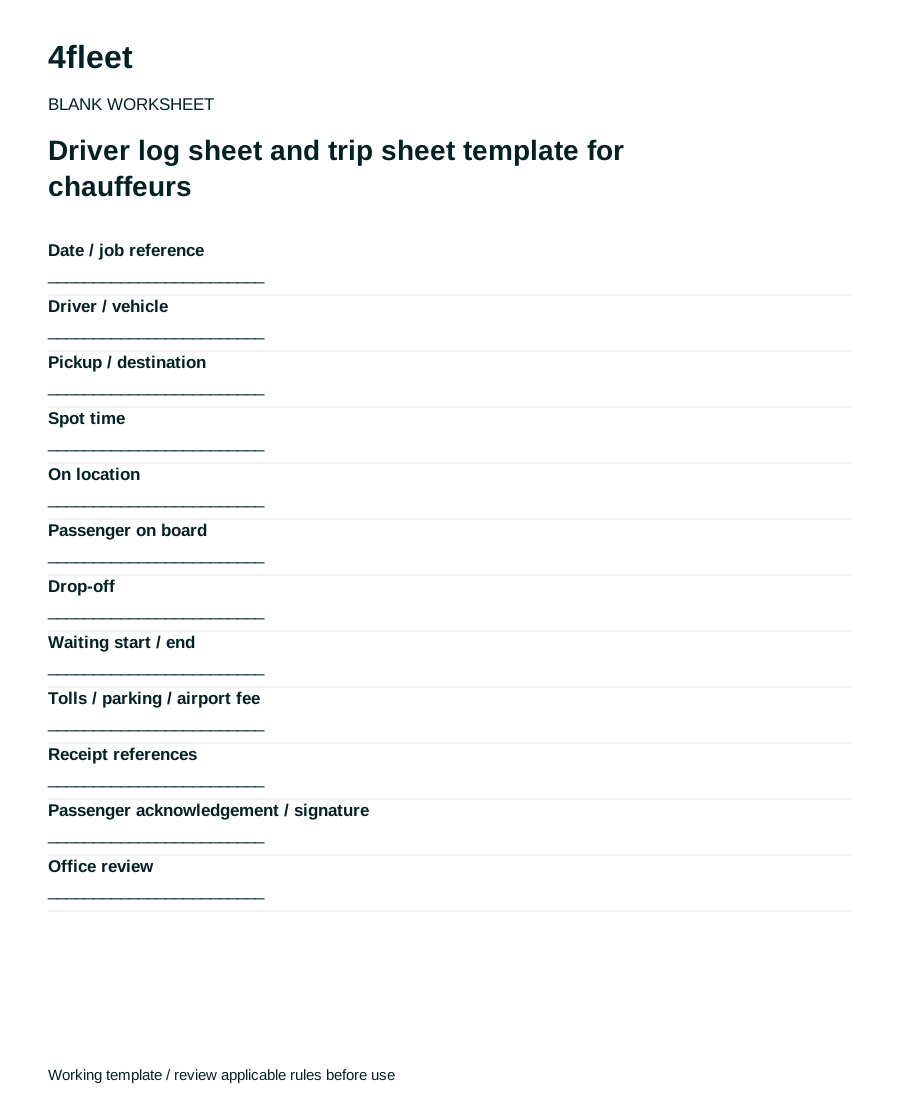
What the trip sheet records
Keep planned instructions and actual events separate. Use dates for jobs crossing midnight, and local time zones where needed for an unambiguous handover.
| Field block | What to record |
|---|---|
| Job and people | Identify the job, driver, vehicle and route. Link the sheet to passenger instructions held securely elsewhere using the booking reference. |
| Spot and arrival | Spot time is the time the operator asks the vehicle to be positioned and ready. Record the actual on-location time separately. An arrival at the terminal entrance is not necessarily an arrival at the agreed passenger meeting point. |
| Passenger movements | Record passenger-on-board and drop-off times as actual events. Note a changed destination or additional stop and who authorised it. Do not replace an observed time with the schedule because the booking ran late. |
| Waiting and extras | Show waiting intervals and the agreed charging basis. Record tolls, parking and airport fees with receipt references and currency. A cost incurred by a driver is not automatically a charge approved for the customer invoice. |
| Acknowledgement and daily log | The passenger acknowledgement line is optional operational evidence, not an electronic signature service. The separate daily page records jobs, duty start/end, breaks and office review. It is not a prescribed record of duty status. |
How to fill in a trip sheet per job
Confirm the brief
Check pickup location, spot instruction, passenger contact and route before departure. Keep a reliable office contact available for changed instructions. Fill only what you know; do not pre-sign completion or predict a passenger-on-board time.
Record actual events
Add on-location, on-board and drop-off times when they occur. Record waiting where it happened, including before boarding or at an additional stop. Keep receipts connected to their extra line and note the relevant currency.
Hand over the evidence
Check the sheet after the job, explain differences from the brief and send the record through your agreed secure process. The office reviews extras before billing. Complete the separate daily operational log without treating it as a legal hours certificate.
Hours-of-service and record rules by market
United States
FMCSA passenger-carrying CMV rules differ from property-carrier rules. Part 395 governs applicable driving time and duty records, with operation-specific exceptions. The linked passenger guidance is the starting point; a booking timeline or this daily worksheet is not a compliant ELD.
FMCSA passenger hours-of-service guidance · verified on 2026-10-20Great Britain
DVSA guidance distinguishes passenger-vehicle drivers-hours regimes and tachograph requirements. Confirm the regime for the vehicle and service, including any exemption; do not copy a bus rule onto every private-hire car. Northern Ireland has separate guidance.
DVSA passenger drivers hours and tachographs · verified on 2026-10-20Ireland
Use RSA guidance to establish the drivers-hours and tachograph rules for the vehicle and service. Occasional passenger services can have additional conditions. This sheet records job events only and does not calculate driving limits, rest entitlement or tachograph compliance.
RSA tachographs and drivers hours · verified on 2026-10-20Canada
The National Safety Code includes driver hours-of-service standards, implemented within the applicable federal or provincial framework. Check the governing regime before choosing a daily record. An operational job sheet does not establish exemption from a required electronic logging system.
CCMTA National Safety Code, Standards 9 and 13 · verified on 2026-10-20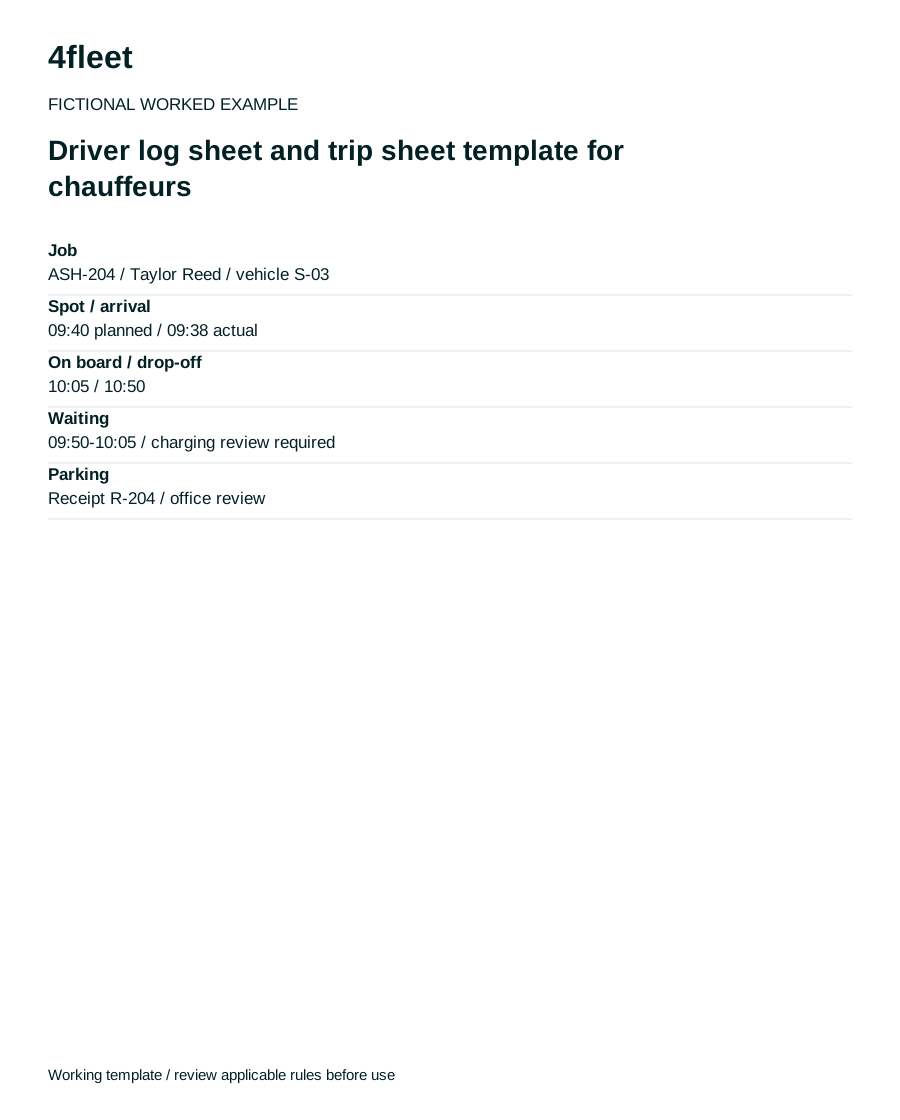
From blank sheet to useful record
A completed trip sheet
The fictional Ashford Chauffeurs example shows a 09:40 spot instruction, actual arrival at 09:38, passenger on board at 10:05 and drop-off at 10:50. The 09:50-10:05 waiting interval is recorded for office review, not automatically charged. A parking receipt is referenced without inventing a tariff. The daily sheet separately records the driver working period and breaks. These example times describe one imagined job, not a recommended shift pattern or an hours-of-service allowance.
- Job
- ASH-204 / Taylor Reed / vehicle S-03
- Spot / arrival
- 09:40 planned / 09:38 actual
- On board / drop-off
- 10:05 / 10:50
- Waiting
- 09:50-10:05 / charging review required
- Parking
- Receipt R-204 / office review
Trip details in the 4fleet driver app
Keep job references on receipts and proof photos, with clear responsibility for reviewing returned sheets and revised instructions.
4fleet driver job details include the working brief and proof-photo capture. Jobs can also hold billable extras such as tolls, parking, waiting time and airport fees. Those features support the operational handover; they do not turn the driver app into a statutory hours-of-service recorder. The figures show the fictional Ashford job brief and office schedule, not a completed legal log.
See the driver job workflow
The driver brief brings the pickup instructions together. Proof-photo capture is a separate job action.

The office schedule gives the job context; actual job events still need to be recorded.
Trip sheet questions
What is a trip sheet in the limo business?
It is the operational record for a job: who drove, where the passenger travelled, the actual times, changes and extras. It gives the office evidence to review after service.
What is spot time?
Spot time is the instructed time for the vehicle to be positioned and ready. It may precede passenger pickup. Agree the meaning with dispatch and record actual arrival separately.
Do chauffeurs need a daily driver log?
It depends on the applicable vehicle and operating rules. This daily sheet is an office record; it does not replace a required record of duty status, ELD or tachograph.
Who keeps the trip sheets, driver or operator?
Follow the operator filing procedure and applicable retention rules. Assign a responsible custodian, give drivers a secure return method and keep the job reference on the retained copy.
Can trip sheets be digital?
Yes, an operational sheet can be kept digitally. Choose controlled access, readable exports and a filing process. Check separately whether a particular legal record accepts that format and what additional requirements apply.
General information, not legal or tax advice. Sources verified on 2026-10-20; check the relevant authority before acting.